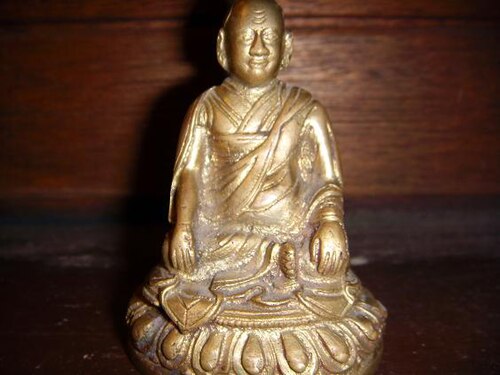
About
Longchenpa (1308–1364) was a Tibetan Buddhist master and scholar regarded as one of the most brilliant minds in the Nyingma tradition. His masterwork, the 'Seven Treasuries,' systematized the Dzogchen teachings into a comprehensive philosophical and meditative framework. His writings remain foundational texts for the study and practice of the Great Perfection.
Teachings
Videos
Books
Padma Rigdzin Ling Buddhist Temple www.padmarigdzinling.org ཚོགས་གི་སྐབས་སུ་ཉེར་བར་མཁོ་བའི་ཞལ་འདོན་ཕྱོགས་བསྡུས་བཞུགས་སོ། A Collection of Essential Tsok Offering Prayers (5.5 x 7.5 black and white book)
Collection of Essential Tsok Offering PrayersThis book contains various prayers that are used in Padma Rigdzin Ling's rituals and ceremonies, such as the Tsok Offering with the Rigdzin Dupa and such as the Green Tara Mandala puja.Table of ContentsThe Verses of the Eight Noble Auspicious Ones........
A new translation of the Tibetan master Longchenpa’s famous work that systematically presents the path of yogic conduct according to the Dzogchen tradition Finding Rest in Illusion is the third volume of the Trilogy of Rest, Longchenpa’s classic exposition of the Buddhist path. The purpose of these teachings is to introduce us to our most basic nature—the clear and pristine awareness that is the nature of the mind. According to the traditional Tibetan Buddhist formula of view, meditation, and action, this volume follows Finding Rest in the Nature of the Mind, which establishes the view of the Buddhist path generally, and specifically that of the teachings of the Great Perfection, and Finding Rest in Meditation, which outlines the main points of meditation, namely, where one should meditate, what qualities a practitioner should possess and develop, and what should be practiced. The Padmakara Translation Group has provided us with a clear and fluid new translation of the final volume of the trilogy, Finding Rest in Illusion, along with its autocommentary, The Chariot of Excellence, both intended to elucidate the appropriate action of a Buddhist practitioner. Finding Rest in Illusion describes in detail the conduct of those who have stabilized their recognition of the nature of the mind and how to apply the Buddhist view when relating to ordinary appearances. Drawing extensively from classic Buddhist works, the author uses well-known examples of illusion found throughout Mahāyāna literature to illustrate the illusory nature of both saṃsāra and nirvāṇa, thus revealing their ultimate nondual nature. This is an invaluable manual for any genuine student of Buddhism who wishes to truly find rest through the path of the Great Perfection.
A new translation of the Tibetan master Longchenpa’s famous work that systematically presents the path of meditation according to the Tibetan Dzogchen tradition Finding Rest in Meditation is the second volume of the Trilogy of Rest, Longchenpa’s classic exposition of the Buddhist path, the purpose o
Released in paperback for the first time, this brilliant translation of Longchenpa's famous work presents the entire scope of the Buddhist view combined with pith instructions for pointing out the nature of one's mind. Longchen Rabjam's Finding Rest in the Nature of the Mind is a classic Buddhist manual for attaining true liberation through familiarizing ourselves with our most basic nature--our clear, pristine, and aware mind. Written in the fourteenth century, this text is the first part to Longchenpa's Trilogy of Rest, a work of the esoteric Tibetan Dzogchen tradition. This unique presentation of the Buddhist view and path combines the scholastic expository method of explanation with direct pith instructions designed for yogi practitioners. This text systematically presents the view in thirteen chapters, outlining all that a practitioner must know in order to embark on the complete Buddhist path. Here we find fundamental instructions on the need to turn away from materialism, how to find a qualified guide, how to develop boundless compassion for all beings, tantra and its associated practices, calm abiding (śamatha) and deep insight (vipaśyanā) meditation techniques, all culminating in the practice presented from the perspective of Dzogchen. This first volume of the Trilogy of Rest is a comprehensive teaching on the view from the Tibetan Buddhist tradition, setting the foundation for the following two volumes: Finding Rest in Meditation, which focuses on meditation practice, and Finding Rest in Illusion, which focuses on post-meditation yogic conduct. The Padmakara Translation Group has provided us with a clear and fluid new translation of Finding Rest in the Nature of the Mind, which will serve as a genuine aid to study and meditation.
Le Tibet et sa culture offrent à l'Occident la double face d'un mythe : fasciné, le public n'en est pas mieux informé, et l'intérêt face à la mystique orientale reste encombré de préjugés. Cet ouvrage se propose d'exposer de façon claire et précise un aspect mal connu de la pensée tibétaine : l'ense
This classic collection of texts on the meditation practice and theory of Dzogchen presents the Great Perfection through the writings of its supreme authority, the fourteenth-century Tibetan scholar and visionary Longchen Rabjam. The pinnacle of Vajrayana practice in the Nyingma tradition of Tibetan Buddhism, Dzogchen embodies a system of training that awakens the intrinsic nature of the mind to reveal its original essence, utterly perfect and free from all duality—buddha nature, or buddhahood itself. In The Practice of Dzogchen, Tulku Thondup translates essential passages from Longchen Rabjam’s voluminous writings to illuminate and clarify this teaching. He also draws on the works of later masters of the tradition, placing Dzogchen in context both in relation to other schools of Buddhism and in relation to the nine-vehicle outline of the Buddhist path described in the Nyingma tradition. This expanded edition includes Counsel for Liberation, Longchenpa’s poetic exhortation to readers to quickly enter the path of liberation, the first step toward the summit of Dzogchen practice.
In this collection of spiritual instructions, fourteenth-century Tibetan Buddhist master Longchenpa offers a comprehensive guide to achieving enlightenment, presented here with Dilgo Khyentse Rinpoche’s practical commentary. The text offers clear and direct guidance for practitioners at every level,
The third volume of the Collected Works of the modern Tibetan master Khangsar Tenpa’i Wangchuk, this is the first published translation of a commentary on the 14th-century master Longchenpa’s Precious Treasury of the Dharmadhātu, a verse text on the direct practices to realize the nature of mind tau
The first and only commentary on the Buddhist master Longchenpa's essential text on Dzogchen by modern scholar and Nyingma master, Khangsar Khenpo Tenpa'i Wangchuk. Longchen Rabjam (1308-1363), also known as Longchenpa, is a great luminary of Tibetan Buddhism. Regarded as a master of Dzogchen, or Great Perfection, Longchenpa's prolific writings have made him one of Tibet's most renowned and precious teachers. In clear and elegant verse, Longchenpa's Precious Treasury of the Fundamental Nature establishes the definitive view of the ultimate nature of mind according to the secret class of pith instructions of the Great Perfection. Aside from the auto-commentary composed by Longchenpa himself in the fourteenth century, the first and only commentary ever to have been written on this work was composed in the twentieth century by Khangsar Khenpo Tenpa'i Wangchuk, a teacher, scholar, and preserver of Buddhist monastic and scholarly culture in Tibet. This work marks the first step in translating the collected works of this modern Nyingma master. In this commentary, Khangsar Khenpo guides Dzogchen practitioners to experience and understand the phenomena of the outer world detected by the senses as well as the subjective mental and emotional states that apprehend them in order to bring the student to a recognition and stabilized experience of ultimate truth.
Just as the images on television are nothing more than light, so are our experiences merely the dance of awareness. Often we form attachments to or feel enslaved by these experiences. But they are only reflections. As easily as television pictures vanish when the channel is changed, the power of our
Know a video or talk by Longchenpa we should add?