About
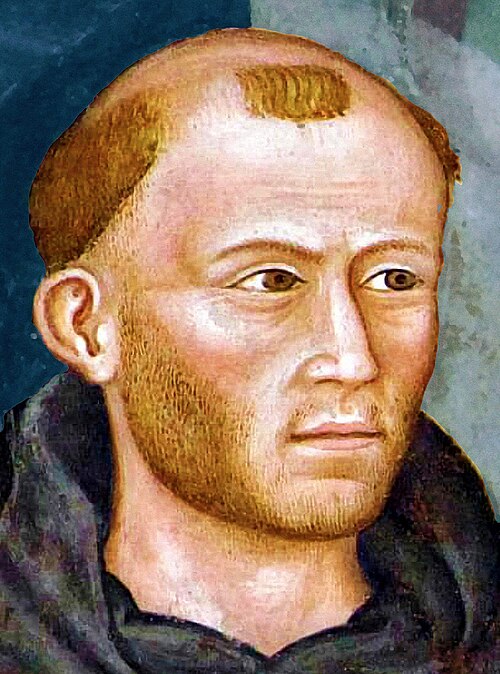
Meister Eckhart (c. 1260–1328) was a German Dominican theologian, philosopher, and mystic whose sermons on detachment, the birth of the Word in the soul, and the Godhead beyond God made him one of the most radical voices in Christian mysticism. He taught at the University of Paris and held leadership positions in the Dominican order. Though some of his propositions were condemned posthumously, his influence on later mystics and modern contemplative traditions has been profound.
Teachings
Videos
Books
Meister Eckhart (c. 1260-1327) was a Dominican philosopher and spiritual master whose thought is among the most daring and difficult in the history of western mysticism. This volume contains his technical Latin writings and more popular German sermons.
Eckhart von Hochheim O.P. (c. 1260 - c. 1328), commonly known as Meister Eckhart, was a German theologian, philosopher and mystic, born near Gotha, in the Landgraviate of Thuringia in the Holy Roman Empire. Eckhart came into prominence during the Avignon Papacy, at a time of increased tensions between monastic orders, diocesan clergy, the Franciscan Order, and Eckhart's Dominican Order of Preachers. In later life, he was accused of heresy and brought up before the local Franciscan-led Inquisition, and tried as a heretic by Pope John XXII. He seems to have died before his verdict was received. He was well known for his work with pious lay groups such as the Friends of God and was succeeded by his more circumspect disciples John Tauler and Henry Suso. Since the 19th century, he has received renewed attention. He has acquired a status as a great mystic within contemporary popular spirituality, as well as considerable interest by scholars situating him within the medieval scholastic and philosophical tradition.
A faithful and authoritative translation of this fourteenth century Dominican theologian, who became the greatest of all German mystics.
"Bargains in books are rare today, but one would be hard put to find in American publishing anything superior to these in content and format." The Parish Visitor Meister Eckhart: Teacher and Preacher edited by Bernard McGinn with the collaboration of Frank Tobin and Elvira Borgstadt preface by Kenneth Northcott "When this temple is thus free of all obstacles, namely, possessiveness and ignorance, then it sparkles so beautifully and shines so purely and bright above everything that God created and through everything that God created that no one can be compared to it in brightness but the uncreated God alone...If the soul of a man still living in time were standing on the same level as the highest angel, this person could reach immeasurable higher in his free capability above the angel in ever 'now', new beyond number, that is, and beyond manner and above the manner of the angels and any created intellect." Meister Eckhart (c.1260-1327) Here are the texts that illustrate the diversity of one of the most enigmatic and influential mystics of the Western Christian tradition. Eckhart the teacher is represented by the Commentary on Exodus and by selections from six other commentaries, including the Commentary on Wisdom 7:14, the Commentary on Ecclesiasticus 24:29, and the Commentary on John 14:8. Eckhart's ministry as a preacher was an equally important part of the man, and thus his sermons, from both the Latin and the Middle High German manuscripts, are included. What emerges is a comprehensive picture of the works of this great speculative theologian. Together with Meister Eckhart: The Essential Sermons, Commentaries and Treatises, this work form the most extensive corpus of Eckhart's writings in English. +
Composed during a critical time in the evolution of European intellectual life, the works of Meister Eckhart (c. 1260-1327) are some of the most powerful medieval attempts to achieve a synthesis between ancient Greek thought and the Christian faith. Writing with great rhetorical brilliance, Eckhart combines the neoplatonic concept of oneness - the idea that the ultimate principle of the universe is single and undivided - with his Christian belief in the Trinity, and considers the struggle to describe a perfect God through the imperfect medium of language. Fusing philosophy and religion with vivid originality and metaphysical passion, these works have intrigued and inspired philosophers and theologians from Hegel to Heidegger and beyond.
"Meister Eckhart's complete mystical teachings together in one volume, for the first time! With a foreword by leading Eckhart scholar Bernard McGinn, and the elegant translation of Maurice O'C Walshe, this comprehensive and authoritative work is a treasure for every serious spiritual seeker, and the finest volume on Eckhart ever to appear in English."--Publisher's website.
In this remarkable work, Reiner Schürmann shows Meister Eckhart, the thirteenth-century Christian mystic, as the great teacher of the birth of God in the soul, which shatters the dualism between God and the world, the self and God. This is an exposition of Eckhar's mysticism--perhaps the best in English--and, because Eckhart is a profound philosopher for whom knowing precedes being, it is also an exemplary work of contemporary philosophy. Schürmann shows us that Eckhart is our contemporary. He describes the threefold movement of detachment, release, and "dehiscence" (splitting open), which leads to the experience of "living without a why," in which all things are in God and sheer joy. Going beyond that, he describes the transformational force of approaching the Godhead, the God beyond God: "A man who has experienced the same no longer has a place to establish himself. He has settled on the road, and for those who have learned how to listen, his existence becomes a call. This errant one dwells in joy. Through his wanderings the origin beckons."
Know a video or talk by Meister Eckhart we should add?