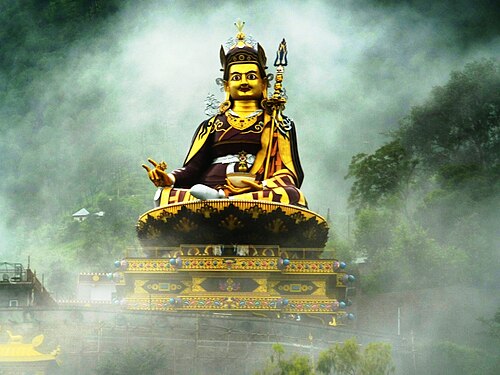
About
Padmasambhava, known as Guru Rinpoche, was an eighth-century Indian tantric master credited with establishing Buddhism in Tibet. He subdued local deities and consecrated Samye, Tibet's first Buddhist monastery, at the invitation of King Trisong Detsen. Revered as a second Buddha by the Nyingma tradition, he is said to have concealed treasure teachings (terma) throughout Tibet for future generations.
Teachings
Videos
Books
A core text of the Nyingma tradition of Tibetan Buddhism, presented in English for the first time, with commentary by Jamgön Mipham, one of the Nyingma tradition's most lucid and brilliant minds. A concise commentary by the eighth-century Indian Buddhist master Padmasambhava on a chapter from the Guhyagarbha Tantra, which gives an overview of the different Buddhist and non-Buddhist philosophical views, including the Great Perfection (Dzogchen), with an explicative commentary by the nineteenth-century scholar Jamgön Mipham (1846-1912). Padmasambhava's text is a core text of the Nyingma tradition because it provides the basis for the system of nine vehicles (three sutra vehicles and six tantra vehicles) that subsequently became the accepted way of classifying the different Buddhist paths in the Nyingma tradition. Mipham's commentary is the one most commonly used to explain Padmasambhava's teaching. Mipham is well known for his prolific, lucid, and original writings on many subjects, including science, medicine, and philosophy, in addition to Tibetan Buddhist practice and theory.
This book explores chapter 5 of the Bardo Thödol titled ‘The Spiritual Practice entitled Natural Liberation of Habitual Tendencies’. This text incorporates a detailed exposition of the transformation of saṃskāras (consciousness attributes developed through past activity) into enlightenment attributes. This book provides a solid foundation to understanding the force centres (chakras) and the way their powers (siddhis) awaken. The ten stages of the evolution of consciousness are illustrated in correspondence with the doctrine of the Peaceful and Wrathful Deities and how they contribute to the Initiation process.
The source of activity is the dakini and there are five kinds of activities, peaceful, increasing, magnetizing, subjugating, and the supreme activity. The primary way to perfect these is through dakini practices, and among dakinis, there are the wisdom dakinis, in space, and worldly dakinis. These vast collections of practices can be condensed into those of the three roots, lama, yidam, and dakini. The source of blessings is the lama, the source of accomplishment is the yidam, and the source of activities is the dakinis. The one who carries out the activities for the lama and the yidam is the dakini, in other words, the virtue of blessings and accomplishment is the activity, which is the dakini. Pema Khandro practice connects us with magnetizing practices. And why do we do magnetizing practice? The real essence that needs to be magnetized is not superficial things; it is to magnetize realization of the view, to magnetize the teachings on how to realize the view, to magnetize the meditation and the conduct.--Padmasambhava "book"
The words of advice collected here are part of the ancient tradition of religious texts known as terma that were hidden in secret places during the first spread of Buddhism in Tibet in the ninth century.
The Light of Wisdom Vol. I contains the root terma ---hidden treasure text --- of Padmasambhava, The Gradual Path of the Wisdom Essence and its commentary The Light of Wisdom by Jamgon Kongtrul the Great. Annotations on the commentary Entering the Path of Wisdom spoken by Jamyang Drakpa and recorded by Jokyab Rinpoche are included as well as clarifications from other masters. Volume I presents in-depth explanations of the Vajrajana Buddhist perspective. It begins with the nature of the ground, the buddha nature present in all beings, continues with the teachings that are common to all vehicles, and concludes with the Mahayana and the link to Vajrayana. This essence of the causal and resultant vehicles, Especially the core of the realization the three sections of the inner tantras, Linking together the ground with the path, Makes you abandon the temporary defilements along with their tendencies, Realize fruition and quickly accomplish the welfare of self and others, In this way it is in conformity with each yet exalted above them all. -Padmasambhava The root text of Lamrim Yeshe Nyingpo, a terma revealed by the great treasure- finder Chokgyur Lingpa, and its commentary by Kongtrul Rinpoche, the great translator in person, form together a complete scripture that embodies all the tantras, statements and instructions of the Nyingma School of the early translations, which is most rare to find in the past, present, or future. -Kyabje Dilgo Kyentse Rinpoche
A perfect companion to the well-known Tibetan Book of the Dead. In life and in death, in meditation and in sleep, every transitional stage of consciousness, or bardo, provides an opportunity to overcome limitations, frustrations, and fears. The profound teachings in this book provide the under- standing and instruction necessary to turn every phase of life into an opportunity for uncontrived, natural liberation. Like the Tibetan Book of the Dead, Natural Liberation is a terma, a "hidden treasure" attributed to the eighth-century master Padmasambhava. Gyatrul Rinpoche's lucid commentary accompanies the text, illuminating the path of awakening to the point of full enlightenment. Natural Liberation is an essential contribution to the library of both scholars and practitioners of Tibetan Buddhism.
Perfect Clarity is an anthology of essential writings on Mahamudra and Dzogchen for the student of Tibetan Buddhism. Mahamudra, a meditation practice focusing on the nature of mind, and Dzogchen, a body of teachings aimed at realizing the "great perfection" or natural, primordial state, are central to Vajrayana practitioners today.--
These Tibetan Buddhist teachings provide instructions for gathering and harnessing basic life energy. According to the tradition, a very effective way to do this is to arouse sexual energy and to direct the essence of that energy toward spiritual realization. According to the philosophy, sexual energy brings one naturally and effortlessly into flow with creativity and awareness in both mind and body—when used skillfully by committed practitioners with appropriate training. These ancient texts, attributed to the great Tibetan meditation master Padmasambhava (who practiced sexual union with the famous Tibetan queen Yeshe Tsogyal), offer traditional Buddhist teachings on the nature of the elements that all beings and our world are made of. They show us a practical view of how to use life-energy for personal development. The teachings are for experienced Buddhist practitioners.
In 1927, Oxford University Press published the first western-language translation of a collection of Tibetan funerary texts (the Great Liberation upon Hearing in the Bardo) under the title The Tibetan Book of the Dead. Since that time, the work has established a powerful hold on the western popular imagination, and is now considered a classic of spiritual literature. Over the years, The Tibetan Book of the Dead has inspired numerous commentaries, an illustrated edition, a play, a video series, and even an opera. Translators, scholars, and popular devotees of the book have claimed to explain its esoteric ideas and reveal its hidden meaning. Few, however, have uttered a word about its history. Bryan J. Cuevas seeks to fill this gap in our knowledge by offering the first comprehensive historical study of the Great Liberation upon Hearing in the Bardo, and by grounding it firmly in the context of Tibetan history and culture. He begins by discussing the many ways the texts have been understood (and misunderstood) by westerners, beginning with its first editor, the Oxford-educated anthropologist Walter Y. Evans-Wentz, and continuing through the present day. The remarkable fame of the book in the west, Cuevas argues, is strikingly disproportionate to how the original Tibetan texts were perceived in their own country. Cuevas tells the story of how The Tibetan Book of the Dead was compiled in Tibet, of the lives of those who preserved and transmitted it, and explores the history of the rituals through which the life of the dead is imagined in Tibetan society. This book provides not only a fascinating look at a popular and enduring spiritual work, but also a much-needed corrective to the proliferation of ahistorical scholarship surrounding The Tibetan Book of the Dead.
Know a video or talk by Padmasambhava we should add?